
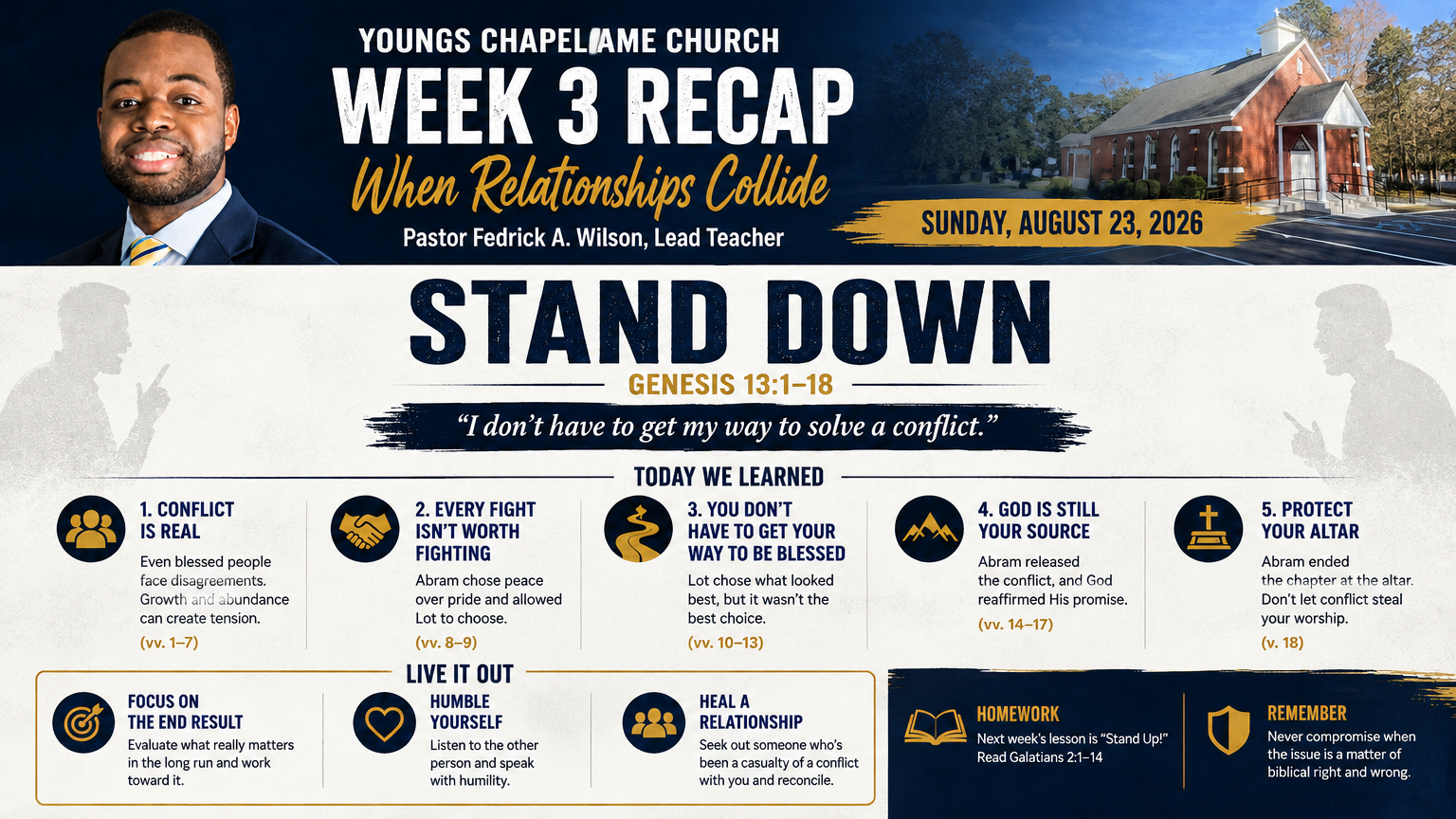
WHEN RELATIONSHIPS COLLIDE YOUNGS CHAPEL AME CHURCH – IRMO, SC
PASTOR FEDRICK A. WILSON – LEAD TEACHER
Session 3 – Student Bible Study Notes LESSON SUBJECT: “STAND DOWN”
Scripture: Genesis 13:1–18
Tuesday, August 25, 2026 – 7pm
Central Truth:
“I don’t have to get my way to solve a conflict.”
Lesson Goal
To learn that standing down is not always weakness. Sometimes spiritual maturity means surrendering our personal preference, pride, or desire to win in order to preserve peace and relationships while trusting God with the outcome.
I. THE PROBLEM: BLESSINGS CAN STILL BRING CONFLICT
Genesis 13:1–7
Abram had become very wealthy in livestock, silver, and gold. Lot also possessed flocks, herds, and tents. Eventually, there was not enough land to support both households, and conflict developed between their herders.
Key Lessons
1. Conflict is a normal part of relationships.
Even people who love each other can disagree.
2. Growth can create tension.
Abram and Lot were not fighting because they had nothing. Their prosperity created new pressures.
3. MORE blessing requires MORE maturity.
As our families, churches, careers, and responsibilities grow, our ability to communicate and resolve conflict must grow too.
4. Our conflicts affect other people.
Genesis 13:7 notes that the Canaanites and Perizzites were also living in the land. How we handle disagreements can influence our families, church, workplace, and community.
Reflection
What usually causes the most conflict in relationships today?
II. THE RESPONSE: EVERY FIGHT ISN'T WORTH FIGHTING
Genesis 13:8–9
Abram approached Lot and said they should not continue quarreling because they were family. He then allowed Lot to choose which direction he wanted to go.
Key Principle
The relationship can be more valuable than winning the argument.
Abram could have insisted on getting his way, but instead he took the initiative to resolve the conflict.
Ask Yourself
Before continuing an argument:
• Is this a principle or merely my preference?
• Will this matter five years from now?
• Am I trying to solve the problem or simply prove that I'm right?
• What will winning this argument cost the relationship?
Remember
Standing down does NOT mean:
• accepting abuse
• tolerating injustice
• abandoning biblical convictions
• allowing someone to continually mistreat you
• having no healthy boundaries
Standing down means recognizing when peace is more important than getting your personal preference.
III. THE CHOICE: YOU DON'T HAVE TO GET YOUR WAY TO BE BLESSED
Genesis 13:10–13
Lot looked over the land and chose the well-watered Jordan plain. It appeared to be the better opportunity. Abram allowed him to make his choice.
Key Lesson
What looks best is not always what is best.
Lot made his decision largely according to what he could see. The passage also warns that he pitched his tents near Sodom, whose people were living in serious sin.
Before making a decision, don't only ask:
“What looks good?”
Also ask:
“Where is God leading me?”
IV. THE PROMISE: GOD IS STILL YOUR SOURCE
Genesis 13:14–17
After Lot departed, God spoke to Abram and told him to look north, south, east, and west. God reaffirmed His promise concerning Abram's future and descendants.
Remember
Abram gave Lot a choice, but Abram did not give Lot control over his destiny.
Someone else's decision does not cancel God's purpose for your life.
You can stand down because:
• You don't have to force every opportunity.
• You don't have to manipulate people.
• You don't have to win every argument.
• You don't have to fight for everything.
• You can trust God with what comes next.
When you know God is your source, you don't have to treat every disagreement like your destiny depends on winning.
V. PROTECT YOUR ALTAR
Genesis 13:18
After everything happened, Abram moved near the great trees of Mamre at Hebron, pitched his tents, and built an altar to the Lord.
Conflict changed Abram's circumstances, but it did not destroy his devotion to God.
What does it mean to “protect your altar”?
Protecting your altar means refusing to allow conflict with another person to interfere with what God is doing within you.
Practically:
• Pray before reacting.
• Guard your words.
• Don't allow bitterness to control you.
• Maintain your prayer and worship life.
• Protect your character.
• Establish healthy boundaries when necessary.
• Trust God with what you cannot control.
Remember
“I'd rather lose an argument and keep my altar than win an argument and lose my worship, my peace, and my character.”
LIVE IT OUT
The lesson gives us three practical actions.
1. Focus on the End Result
Evaluate what really matters in the long run and work toward it.
Ask yourself:
“What outcome am I really seeking?”
Peace? Reconciliation? Understanding? Healing? Or simply winning?
2. Humble Yourself
Listen to the other person and speak with humility.
Listening does not mean agreement.
Try saying:
“Help me understand how you see this.”
3. Heal a Relationship
Identify someone who has been hurt by a conflict involving you and, where appropriate, take a step toward reconciliation.
That might mean:
• making a phone call
• apologizing
• listening
• forgiving
• clearing up a misunderstanding
• admitting your part
• establishing a healthier relationship going forward
PERSONAL REFLECTION
Where might God be calling me to “stand down”?
Is there a relationship God is calling me to help heal?
What action will I take this week?
THIS WEEK'S CHALLENGE
Before responding to your next disagreement, ask:
Does this require me to stand up for what is right—or can I stand down for the sake of peace?
Then remember:
I don't have to get my way to solve a conflict.
NEXT SESSION: STAND UP!
Read: Galatians 2:1–14
Next week we will examine the other side of Christian conflict resolution. There are situations where standing down would mean compromising something that matters.
The next lesson's principle is:
“Never compromise when the issue is a matter of biblical right and wrong.”
Takeaway
We need enough humility to know when to STAND DOWN—
and enough conviction to know when to STAND UP.