
Youngs Chapel AME Church 7336 Carlisle St. Irmo, SC 29063
Bible Study Series “When Relationships Collide”
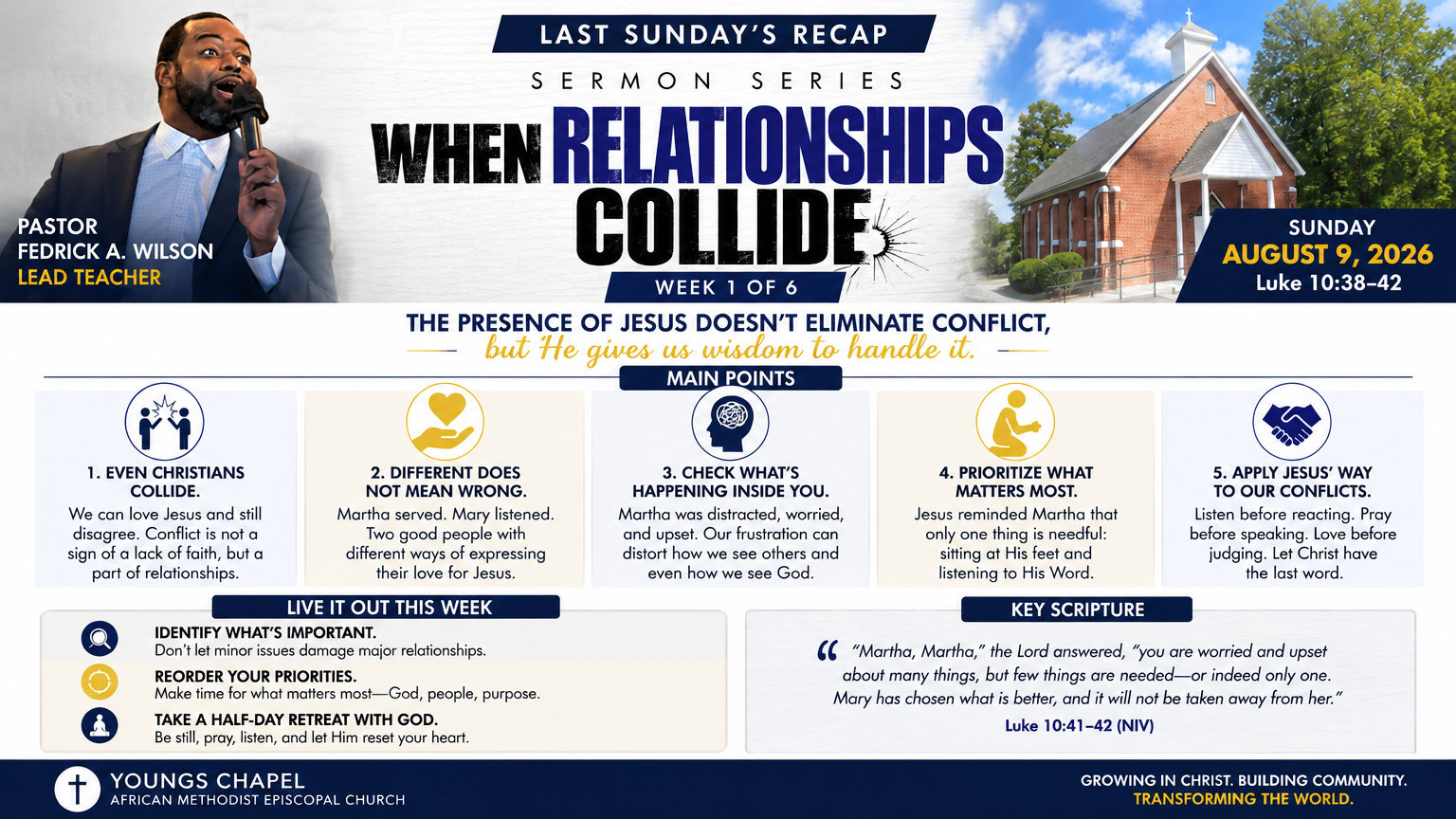
Lesson One Highlights & Notes “Even Christians Collide”
Pastor Fedrick A. Wilson, Lead Teacher
Key Outcomes
Youngs Chapel A.M.E. Church held a virtual Bible study launching a 6-week series titled "When Relationships Collide." The session “Even Christians Collide” used Luke 10:38–42 (Mary and Martha) to establish that conflict is universal — even among believers — and that healthy relationships require listening, reordered priorities, and sitting at Jesus' feet before reacting. Discussion organically extended into parenting, communication, and community resilience.
Decisions Made
• Conflict is not inherently bad — it can expose problems, reveal needs, clarify values, and create opportunities for growth, healing, and reconciliation.
• Unity does not require uniformity — a healthy church is one where people learn to love each other while thinking differently, not one where everyone agrees.
• Priority before activity — before doing for Jesus, we must learn to be with Jesus; before reacting, pray and listen. Core Teaching Points • Martha vs. Mary framing: Martha's service was not wrong; the problem was disordered service — outward action that became inwardly anxious and resentful.
• Key insight: Unresolved frustration with people can distort how we see God — leading to thoughts like "nobody cares" or "even God has forgotten me."
• Jesus addressed Martha's internal condition first, not Mary's behavior — teaching that before blaming others, we must ask: Am I tired? Grieving? Carrying old hurt into a new situation?
• Principle vs. preference: Conflicts often arise from treating preferences (style, timing, tradition) like principles (justice, truth, integrity).
• Sitting at Jesus' feet produces: slowing down before reacting, listening before judging, self examination, receiving grace before extending it, and responding from peace instead of pain.
Discussion Highlights
• Distractions in modern life: Social media and phones cited as primary distractions — checking phones before greeting God in the morning was a commonly shared struggle.
• Conflict in families: Arises from unilateral planning, sibling favoritism perceptions, and generational communication gaps.
• Conflict in churches: Music style preferences (gospel vs. hymns), territorial ownership of roles, and pastoral over-control identified as common sources.
• Listening in parenting: Extended discussion affirmed that open, non-judgmental listening builds lasting trust with children; parents who react emotionally or solve too quickly cause children to stop sharing.
• Notable quote — Mother Beulah Bristow: "Do not expect any more of someone else than you are willing to give yourself."
Community Dimension
• Healthy relationships are a form of community power — internal conflict weakens churches, families, and communities collectively.
• A church cannot effectively challenge injustice if it is constantly fighting internally; a community cannot build economic strength if distrust divides it.
Action Items
• All attendees: Read 1 Samuel 24:1–15 in preparation for next Sunday's sermon and next Wednesday's Bible study, titled "It's Not About Me."
• All attendees: Practice a personal retreat with God — silence, prayer, scripture, journaling, or walking — and pray: "Lord, show me where I am distracted, where I am resentful, and where I need to reorder my priorities."